



Erasmus+ job shadowing is one of the least well-known but most practical forms of mobility in the European program: you don’t go abroad to study in a classroom, but to work alongside professionals in real-world settings, observing how they work and directly experiencing practices and contexts different from your own. In short, you learn by watching those who are already doing what you want to learn to do better.
If you’re a teacher, a trainer, a staff member at a training organization, or a professional working in the field of education, job shadowing is probably the Erasmus+ program that best meets your needs: it doesn’t require you to leave your profession for weeks on end, but rather to immerse yourself in a European work environment for a relatively short period, with specific objectives and formal recognition of the experience.
How does job shadowing actually work?
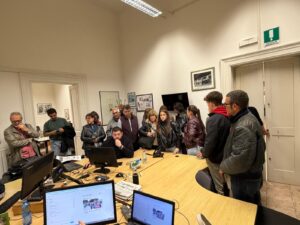
The basic process is simple to describe: a person—usually a professional working in the field of education, training, or youth work—spends a period of time at a partner organization in another European country. During that time, they closely follow colleagues who perform roles similar to their own, participate in daily activities, ask questions, and observe different methods and tools.
This is not an internship in the traditional sense, nor is it a course. Job shadowing involves active observation and professional dialogue, not a lecture. Learning takes place through working together, understanding why a European colleague chooses a certain approach, and comparing one’s own practices with those of a different institutional and cultural context.
The duration varies depending on the project and the agreements between the organizations involved. There is no single format: some experiences last just a few days, while others extend to a few weeks. What matters is that the objectives are defined before departure and that the host organization is prepared to welcome the visitor not as a student or an employee, but as a qualified observer with whom to work as an equal partner.
Who can participate in job shadowing, and in which fields?
Under the Erasmus+ program, job shadowing is primarily intended for staff members of organizations active in education and training: school teachers, vocational trainers, managers of training institutions, educators, and staff members of associations working in the youth sector. This mobility program is not intended for students or those just starting out in their careers; it is aimed at those who already hold a professional role and wish to update their skills, broaden their expertise, or simply view their work from a new perspective.
The areas where job shadowing most often takes place are those related to vocational education and training—the VET sector—but it’s not limited to that. Even those working in non-formal education, youth work, or European project management can find this tool an effective way to grow professionally without interrupting their careers. If you’re curious to see how it works in practice, a visit to a Spanish training center in Salento provides a good example of what a real-life experience is like.
One aspect that often surprises those encountering this tool for the first time is that job shadowing works both ways: you can go to an organization in Europe, but you can also host someone who comes to observe how you work. Being a host organization is not a passive role— welcoming a foreign professional forces you to reflect on your own practices, to make them explicit, and to grapple with questions you wouldn’t normally ask yourself.
What do you take away from an experience like this?
The honest answer is: it depends on how well-prepared you are and how clearly your goals were defined before you left. A well-structured job shadowing experience leaves no room for improvisation: you know what you’ll be observing, you know the questions you want to answer, and you return with materials, notes, and contacts that fuel real change in the way you work.
Formally speaking, the experience is documented and recognized. Youthpass and equivalent tools for adults make it possible to certify the skills developed during the mobility experience, making them transparent and applicable even outside the context of the project. If you want to better understand how this recognition mechanism works, “What You Take Home from an Erasmus+ Mobility Experience” is a good place to start.
In practical terms, the most lasting value is often the least measurable: a personal connection with a European colleague who has solved a problem you’re still grappling with, a method you weren’t familiar with, or a perspective that makes you return to work with a slightly different outlook. That’s no small thing, and you don’t get it by reading a manual.
There is also an organizational aspect that should not be overlooked. When an individual brings home a job-shadowing experience and shares it with their team, the learning effect multiplies without everyone having to travel. This is one of the reasons why many training organizations choose to invest in individual staff mobility as part of a broader professional development strategy.
How do you organize a job shadowing experience under the Erasmus+ program?
Job shadowing cannot be improvised or organized on your own: it is part of an approved Erasmus+ project, built around specific objectives and an agreement between partner organizations. It’s not enough to find a company or organization abroad willing to host you: you need a project framework that defines the activities, guarantees logistical support, and ensures recognition of the experience.
The first step for those working in a training organization or an entity such as a cultural association is to determine whether there is already an active project to join, or whether it is worth developing a new proposal with European partners. Finding the right partners is often the trickiest part: you’re not looking for just any organization, but one with interesting practices that is open to genuine professional dialogue—not just to hosting a visitor.
Here at Sinodia, we’ve been working in the Salento region for years as a point of reference for European organizations looking to organize training and mobility programs in this area. We know what it takes to develop a job shadowing program that makes sense for both participants and host organizations, because we’ve done it from both perspectives. A VET experience in our region demonstrates exactly how this work translates into practice.
If you’re considering how to incorporate job shadowing into your organization—whether you want to send someone abroad or host European professionals in your setting— the best time to start thinking about it is before the call for applications opens, not after. Planning takes time, and partners should be sought out carefully, not in a rush.
Want to find out if job shadowing is right for your organization?
Every organization has different needs, and job shadowing isn’t always the right solution: sometimes a longer exchange is needed, sometimes a structured training course, and sometimes a project partnership that goes well beyond individual mobility. What we can do together is figure out where you stand, what you’re looking for, and which Erasmus+ tool makes the most sense for your specific context.
If you work at a school, a training institution, an association, or any organization involved in education and training in the broadest sense, and you’d like to explore how to make practical and meaningful use of European opportunities, contact us: we’ll start where you are, not where we’d like you to be.
Frequently Asked Questions
Is job shadowing also open to people who work for an organization rather than a school?
Yes, Erasmus+ job shadowing is not limited to schools. Organizations and institutions active in non-formal education, vocational training, or youth work can also participate in this type of mobility, provided they are part of an approved project. It’s worth checking with your national agency to see if your organization meets the requirements.
Do you need to know languages to participate in job shadowing?
A basic knowledge of the host country’s language or of English as a common working language is very helpful. You don’t need to be fluent, but arriving without any language skills makes it difficult to engage in authentic professional interaction, which is at the heart of the experience. Many projects include support for language preparation before departure.
Can I job shadow in a non-European country?
In the standard Erasmus+ framework, job shadowing mobility involves the countries participating in the program, which include European Union countries and some associated countries. Mobility opportunities to third countries exist, but follow different rules. To find out which countries are eligible for a specific project, always contact your country’s Erasmus+ National Agency.
What happens if the host organization isn’t equipped to accommodate an external observer?
This is a real risk, and it’s one of the reasons why the choice of partner must be made carefully before submitting the project. An unprepared host organization can turn a job shadowing experience into a generic visit with no real educational value. Defining a detailed program of activities in advance—agreed upon by both the visitor and the host—is one of the most effective precautions.
Can job shadowing serve as a starting point for a longer-term collaboration?
That’s often exactly what happens. A successful job-shadowing experience builds mutual trust between the organizations involved and paves the way for more structured partnerships: KA2 projects, group exchanges, and European co-design. It doesn’t happen automatically, but direct contact between professionals is the most fertile ground on which to build a lasting collaboration.
How far in advance should you start planning?
Sooner than you might think. Finding reliable partners, developing a solid proposal, and waiting for the evaluation and approval process takes several months. Those who approach a call for proposals without a well-developed proposal are unlikely to submit a high-quality submission. Starting to plan at least six months before the deadline is a conservative estimate, not an optimistic one.