


Galatina is one of those towns that surprises you when you least expect it: it’s not by the sea, nor is it on the main route of the major tourist flows, and yet anyone who visits immediately realizes they’ve discovered something rare. Galatina’s historic center is home to one of the most important frescoed basilicas in all of Southern Italy, a folk tradition that has endured through the centuries without losing its vitality, and an atmosphere that still exudes authentic life.
What sets Galatina apart from other towns in Salento?
Salento is a peninsula known for its recurring natural beauties: crystal-clear seas, farmsteads, and thousand-year-old olive trees. Galatina offers all of this, but adds a dimension that few other towns possess with the same intensity. The city is an open-air archive of medieval and Baroque art and folk traditions, layered over centuries of history ranging from Norman-Swabian rule through the 18th century and beyond.
The urban fabric of the historic center is still clearly visible: churches, noble palaces, inner courtyards, and narrow alleys that open onto unexpected squares. Strolling through the center without a specific destination is already a great way to get to know the city, because every corner tells a story without needing an explanatory sign.
Galatina is also the capital of a region known for its agricultural production: viticulture has ancient roots here, and the wine produced in this area has earned significant national recognition. Galatina’s culture is shaped by the land, liturgy, and collective memory—three elements that are intertwined everywhere, even in art.
The Basilica of Saint Catherine of Alexandria: Why It’s Worth the Trip
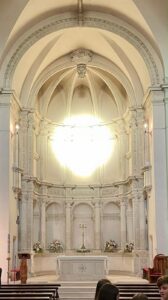
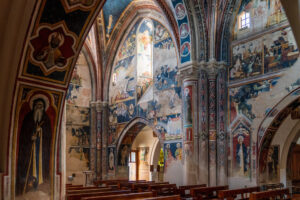
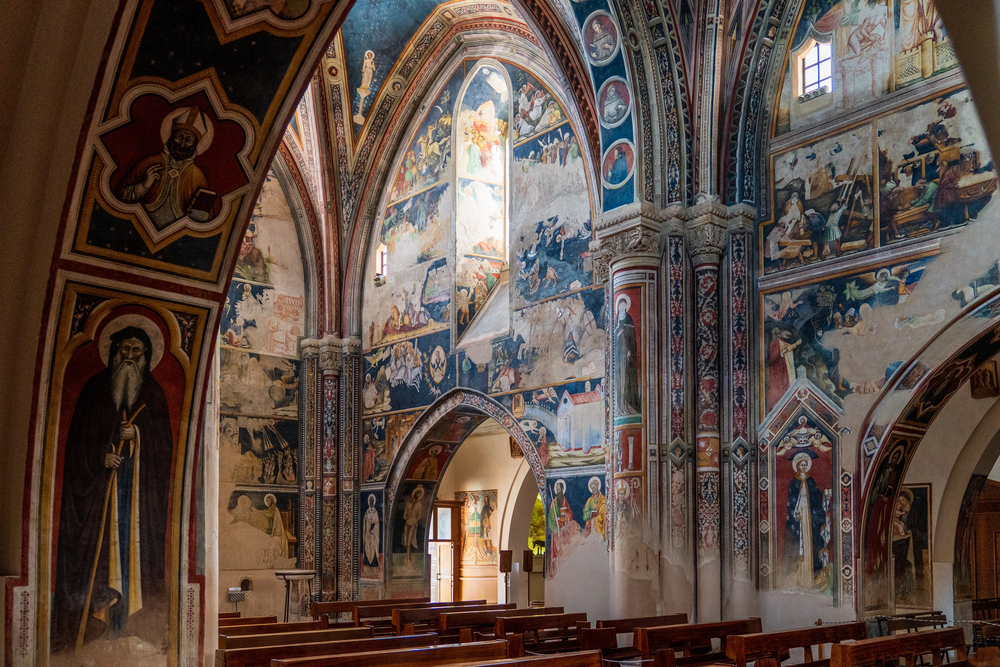
The Basilica of Santa Caterina d’Alessandria is the monumental heart of Galatina and one of the best-preserved medieval complexes in Southern Italy. Its construction dates back to the late 14th century, commissioned by the Princes of Balzo Orsini, and the cycle of frescoes covering the interior walls is what makes it truly exceptional in the artistic panorama of Southern Italy.
The frescoes cover nearly every interior surface of the basilica: vaults, apses, and side aisles. The scenes depict biblical episodes, the lives of saints, and scenes from the Book of Revelation, with an iconographic richness that has no easy parallel in this part of Italy. Those familiar with the Scrovegni Chapel in Padua or the Umbrian basilicas will find a similar narrative logic here: painting as an open book for those who could not read.
The basilica belongs to the Order of Friars Minor Conventual, which oversees its management and preservation. The interior is striking not only for the quality of its frescoes but also for the proportions of its spaces: the Apulian Gothic architecture interacts with Angevin and Byzantine influences in a way that reveals just how much this region served as a crossroads of European and Mediterranean cultures during the Middle Ages.
If you’re leading a group of young people or a class on a visit to Salento, this basilica isn’t just a stop to fill out the itinerary—it’s one of the places where you can truly understand what shared cultural heritage means. An experience like the one described in this educational program in Salento clearly demonstrates how the region itself becomes a tool for learning.
Tarantism and the Feast of Saint Paul: a Tradition Deserving Respect
Galatina is known throughout Europe, among ethnomusicologists and anthropologists, for the phenomenon of tarantism and for the feast of Saint Paul, celebrated annually in June. The connection between the two is ancient and multilayered, and understanding it requires a bit of historical patience and a great deal of care not to simplify what is not simple.
Tarantism was a phenomenon of symbolic possession linked to the bite of the tarantula—or rather, to what the bite symbolized culturally. The “tarantate,” predominantly women, fell into states of prostration that were treated through music, dance, and colors. The “pizzica pizzica,” the frenetic rhythm that accompanied the ritual, served both a therapeutic and a social function: it restored the person’s place in the community through a recognized collective rite.
The Chapel of St. Paul, in the heart of Galatina, was the place where the “tarantate” would go on pilgrimage, convinced that the saint could free them from their condition. This connection between popular devotion, the body, music, and healing has been studied by internationally renowned ethnographers, including Ernesto de Martino, who devoted a seminal study to this phenomenon in the history of Italian anthropology.
Today, the Feast of St. Paul attracts visitors from many parts of Italy and abroad. The risk, as is always the case when a tradition becomes a tourist attraction, is that it will be turned into a spectacle. Approaching this tradition with respect means understanding it first and then observing it—not the other way around. If you’re leading a group on a visit, taking the time to explain the context before you arrive makes all the difference.
Galatina in the Heart of Salento: How It Fits Into a Tour of the Region
Galatina is located just a few kilometers from Lecce and is also easily accessible from Otranto, Gallipoli, and the main coastal towns. Its central location makes it a natural hub for those who want to explore inland Salento—the part that doesn’t show up in the first search engine results but is often what stays with you the longest.
An itinerary that includes Galatina can usefully combine a visit to the basilica with a stroll through the historic center and a stop at the historic cafés in the main square — Galatina is known for its almond pastries and a highly respected confectionery tradition — and, when in season, for taking part in the cultural events that enliven the city.
For groups participating in the Erasmus+ mobility program or for participants in youth exchanges staying in Salento, Galatina offers an opportunity to experience firsthand what intangible cultural heritage means: not a museum, not a theme park, but a city that still lives and breathes its traditions. Comparisons with one’s own culture of origin arise naturally, and this is exactly the kind of learning that a European experience should foster.
If you want to better understand why an experience in the local area can change your perspective, you’ll find a post on our blog about what you learn outside the classroom—it’s worth reading before planning any visit.
Bring something back from Galatina
Galatina isn’t the kind of city you easily forget, precisely because it doesn’t try to impress you. It presents you with an extraordinary medieval basilica, one of Europe’s most studied folk traditions, and a historic center that’s still a living community—not just a museum.
If you’re putting together a cultural itinerary in Salento, Galatina deserves a spot that’s not just a fallback. And if you’re simply looking for a place to better understand this region, start here: often the most interesting answers are found far from the coast.
If you’re thinking of bringing a group to Salento, developing an educational program in the area, or simply wanting to better understand what this part of Southern Italy has to offer, please contact us: we’re based here, we know these places well, and we’d be happy to work with you to figure out how to make them part of a meaningful experience.
Frequently Asked Questions
Is Galatina suitable for a group of young people, or is it better suited for adults?
Galatina works well for groups of any age, as long as the visit is planned in advance. The Basilica of Saint Catherine requires a basic understanding of its context to be truly appreciated. The topic of tarantism, if approached with care, can be very engaging for young people precisely because it speaks directly to the body, music, and community.
How much time do you need to visit Galatina without rushing?
A half-day allows you to explore the basilica and the historic center at your leisure. If you add a stop for traditional sweets and a stroll through the narrow streets, plan on at least four or five hours. For a group wanting to learn more about tarantism or participate in a workshop, a full day is recommended.
Can you visit the basilica and the Chapel of St. Paul on the same day?
Yes, both sites are located in the historic center of Galatina and are easily accessible on foot. Before planning your visit, however, it’s advisable to check the opening hours directly with the management, as they may vary depending on the season and religious holidays.
Is tarantism still practiced today, or is it merely a historical phenomenon?
Tarantism as a widespread therapeutic phenomenon belongs to the past. What survives is the cultural memory, passed down through music, dance, and the Feast of St. Paul. Some scholars use the term “neo-tarantism” to refer to the contemporary revival of these elements, which has played an important role in the resurgence of the pizzica as a musical genre.
Can Galatina be reached by public transport?
Galatina is connected to Lecce by a regional train line and bus services. For those arriving from other areas of Salento, traveling by car is often the most convenient option, especially for groups. It’s always a good idea to check the latest schedules with local transport companies before leaving.
Are there any workshops or immersive experiences related to Galatina’s traditions?
Some local organizations offer pizzica workshops, guided themed tours, and meetings with experts on Salento’s folk traditions. The offerings change over time, so we recommend contacting the cultural associations or the municipal information office directly to find out what’s available during your visit.